Navigation
Accordions
Expand bounded sections while callers retain each section body.
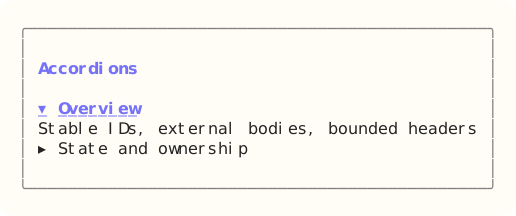
The site build compiles the dedicated Ada component example, constructs Accordions through its public API, and exports that exact styled surface. Read the capture source.
When to use it
Use an accordion when several related sections share one narrow region and users usually need one section at a time.
State and ownership
The Flyology_TUI.Components.Accordions package defines this component.
The model stores stable section IDs, expansion state, focus, and capture. Body surfaces remain caller-owned.
- The application model owner applies updates during serial event dispatch.
- Appearance and skin values are borrowed only while the component renders.
Input and updates
Arrow keys move between headers. Enter, Space, and matching mouse release toggle the focused section.
Integration sequence
- Create the bounded model and populate it with caller-owned data.
- Route the current keyboard or local mouse event through the component handler.
- Apply the typed result, then render from the updated model with the current appearance.
See the linked package reference for its exact declarations and contracts.
Responsive and accessible behavior
- Use dimensions and regions from the current layout or presentation value.
- When a component owns mouse capture, route its matching release even when the pointer leaves the original bounds.
- Retain a glyph, label, border, or text-attribute cue when the terminal reduces color.